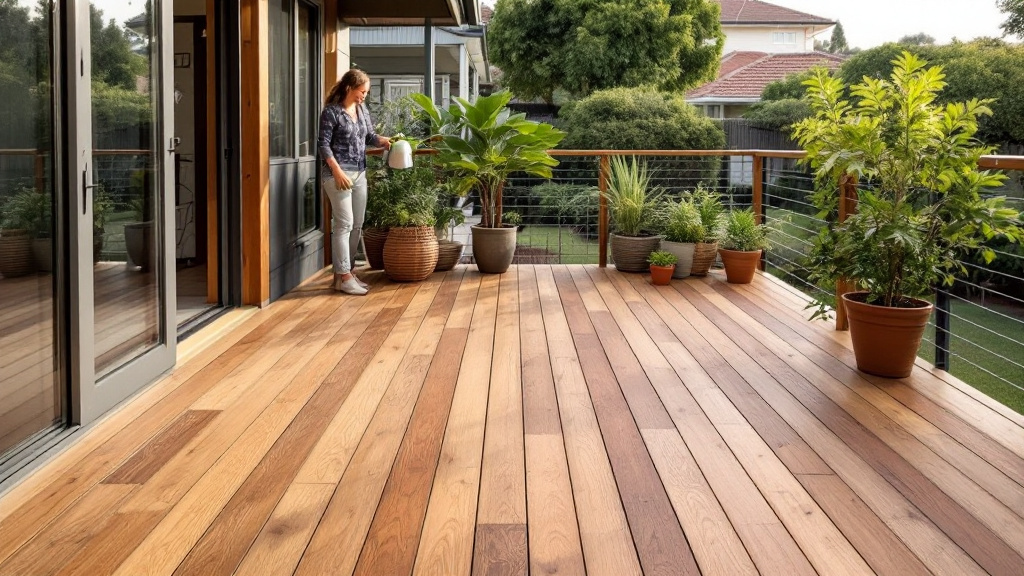
Spotted gum decking is a hard Australian timber that lasts well out in the weather. The colour range also suits both older Queenslanders and new builds, and it’s harvested here in Queensland.
It isn’t perfect. The boards are heavy, and a spotted gum deck goes grey if it isn’t oiled. Here’s what to know before you choose spotted gum decking for your own deck.
Where spotted gum decking comes from
Spotted gum is the name for a few closely related gum trees. They get the name from the bark, which sheds in patches and leaves the trunk looking spotted. Business Queensland’s spotted gum timber profile lists where each type grows, from eastern Victoria up to North Queensland, and says spotted gum is currently the highest-volume native hardwood harvested in Queensland.
The same profile says sawn spotted gum is generally available. It’s used for everything from flooring and cladding to boat decking, and Business Queensland names it the main Australian species for tool handles that take high impact, such as axe handles.
Why spotted gum decking lasts outdoors
The main reason to choose spotted gum is durability. Business Queensland lists it as Class 1 for above-ground durability, with a life expectancy of more than 40 years, and lists it as resistant to termites.
Class 1 is the top rating in the Australian standard for natural durability, AS 5604. WoodSolutions explains the classes on its natural durability ratings page, and spotted gum sits in Class 1 alongside ironbark and tallowwood.
Two things to understand about that rating:
- It applies to heartwood only: sapwood, the pale outer band of the log, is not durable in any species and needs preservative treatment if it is used outdoors.
- It assumes good detailing: WoodSolutions notes that poor ventilation and trapped moisture can shorten the life of even the most durable timber.
So a spotted gum deck lasts when the boards are mostly heartwood and the deck is built so it can breathe and drain.
Spotted gum decking close to the ground
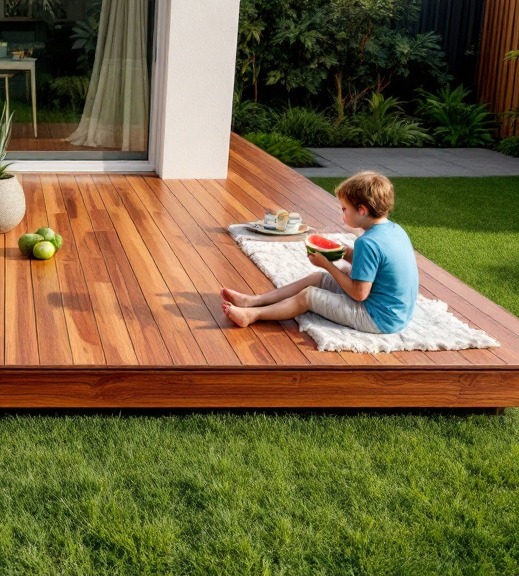
Low decks need extra thought. WoodSolutions says decks with less than 400 mm of clearance under them need Class 1 hardwood or timber treated to H4. Spotted gum heartwood meets that, but the subframe under a low deck still needs to suit the conditions, and airflow under the boards matters more the lower you go.
What spotted gum decking looks like
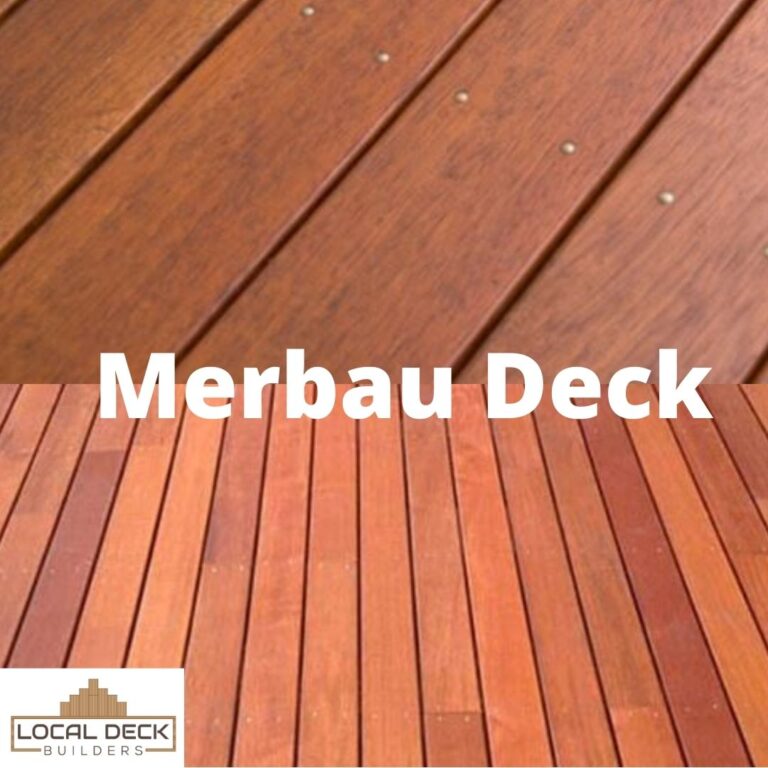
Business Queensland describes spotted gum heartwood as light brown to dark red-brown. That spread is part of the appeal. A spotted gum deck rarely looks flat or uniform, and the texture varies from board to board. Business Queensland notes that gum veins (thin dark lines in the grain) are common, and that wavy grain can give a fiddleback pattern. If you want a perfectly clean, even look, gum veins are worth seeing in person before you order.
The sapwood is white and distinct from the heartwood. Some boards carry a strip of it along one edge. Ask how boards with sapwood are graded and whether they have been treated, because Business Queensland notes untreated spotted gum is susceptible to lyctid borer attack.
How spotted gum decking weathers in the sun
Left bare, any timber deck in Brisbane will go silver grey. WoodSolutions is clear that natural durability does not stop weathering: the surface still greys and can check (fine surface cracks) without a finish.
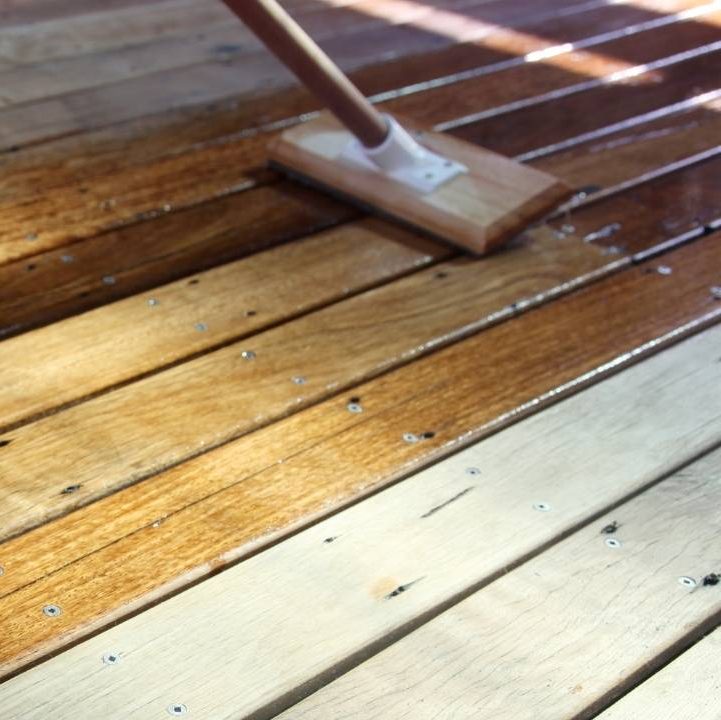
If you like the silver look, keep in mind WoodSolutions still says finishes and good detailing are needed. If you want to keep the warm colour, the deck needs a decking oil or stain and a recoat when it starts to look dry. Decks in full afternoon sun need it more often than shaded ones.
Working with spotted gum decking
Spotted gum is dense. Business Queensland gives a density of around 1010 kg per cubic metre and rates it very hard to work with hand tools. For building a deck, that adds up to this:
- Boards are heavy: carrying and laying them takes more effort than a softwood.
- Fixings: Business Queensland reports no difficulty using standard fittings and fastenings.
- It machines well: the timber has a natural greasiness that helps it cut and plane cleanly.
That hardness is also why it stands up well to foot traffic, outdoor furniture and dogs’ claws. It marks less easily than softer timbers.
Spotted gum decking compared with other hardwoods
WoodSolutions groups common timbers by durability class. Here’s where spotted gum sits on its list.
- Class 1, very durable: spotted gum, ironbark and tallowwood, with more than 40 years expected above ground.
- Class 2, durable: blackbutt, jarrah and silvertop ash, with 15 to 40 years above ground.
- Class 3, moderately durable: Vic ash and Tasmanian oak, with 7 to 15 years above ground.
So if a long life outdoors is what matters most to you, spotted gum is in the top group. Colour is a matter of taste, and it’s worth seeing boards of each timber side by side before you decide.
If you’re weighing these up, our page on timber decks runs through the timber options and what goes into building a deck that lasts.
Questions to ask before ordering spotted gum decking
A few questions up front save surprises later. Ask before you order:
- Grade: which grade of spotted gum decking is being quoted, and how many gum veins and knots that grade allows.
- Sapwood: whether any boards carry sapwood, and if so, whether it has been treated.
- Seasoning: whether the boards are kiln dried, so they have settled before they go down.
- Width: which board width suits the size of your deck and the look you want.
- Fixings: which screws or hidden fixings will be used, especially if you live near the bay.
- Finish: whether the deck will be oiled before it’s handed over, or left for you to do.
Looking after a spotted gum deck
Spotted gum needs the same basic care as any timber deck.
- Sweep it: leaves and dirt hold moisture against the boards.
- Wash it: a gentle deck cleaner and a soft brush lift grime before you recoat.
- Recoat it: when water stops beading on the surface, the oil has worn through.
- Check the gaps: keep the gaps between boards clear so water drains and air moves.
What drives the cost of a spotted gum deck
There’s no single price for a spotted gum deck. The things that move it most are:
- Size and shape: a simple rectangle is quicker to build than a deck with angles or levels.
- Height: a high-set deck needs more posts, bracing, stairs and balustrades.
- Board width and grade: wider boards and more select grades with fewer features cost more.
- The ground: sloping or rocky ground means more work on footings.
- Finish: oiling at the end adds time but protects the deck from day one.
- Approvals: larger, higher or roofed decks may need building approval, which adds a certifier’s fees. Brisbane City Council’s deck approvals page sets out when you need one.
The easiest way to get a real figure is to ask for a free quote with a rough size and a few photos of the area.
Is spotted gum decking right for your home?
If you want a hard-wearing, local hardwood with natural colour variation and you’re happy to oil it now and then, spotted gum decking is a strong choice for a Brisbane home. If you’d prefer a more even colour, look at boards of other timbers in person before you choose. If you never want to oil a deck, a composite board might suit you better.
Local Deck Builders, phone (07) 3667 8081, licence QBCC 15154266.